
Context of the Discovery
In the arid lands of the Ecuadorian coast, in what is now the province of Santa Elena, birthplace of the famous Valdivia culture, a recent discovery could change the entire established chronology of our ancestors as we currently know it.
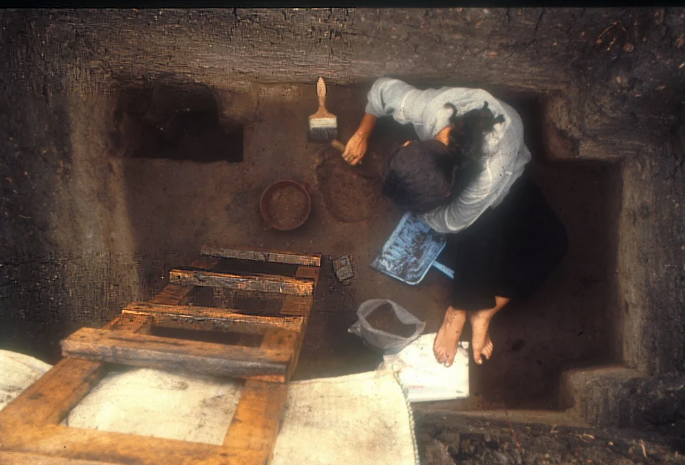
For decades, Real Alto was the archetype of the Valdivia village, with its characteristic central plaza, ceremonial mounds, and oval housing pattern. However, recent test excavations, designed to understand the site's founding phases, have penetrated below the known Valdivia occupation levels. They have reached a sealed stratum, an older occupation layer that, surprisingly, displays radically different material characteristics. This is not an "early" or "formative" Valdivia, but something different.
Researchers and field teams, originally focused on the expansion and definition of the late phases of Valdivia, encountered a set of artifacts and structural remains that, due to their formal, technological, and symbolic characteristics, suggest the presence of a distinct human group. This is not a mere stylistic variation; it is a cultural anomaly. Preliminary reports, already circulating on international archaeology websites such as Ancient Origins, speak of a possible parallel culture, or even more transcendental, of a previously unknown pre-Valdivia horizon.
This discovery is not just a local puzzle. It is a piece that could drastically reconfigure our understanding of the Early Formative Period on the Pacific coast. It forces us to question the narrative of Valdivia as the sole and singular origin of ceramics and complex village life in the region, suggesting a much more diverse and profound cultural landscape than had been assumed for decades.
Roots of the Past: Chronology and Context
To gauge the magnitude of this discovery, it is imperative to situate it within the profound timeline of the Ecuadorian coast. The Valdivia culture, a cornerstone of our formative history, flourished over a long period, generally dated between 3500 and 1800 BC. Its earliest phases (Valdivia I and II) are the foundation of what we understand as "civilization" in this part of the continent.
However, new remains excavated at Real Alto, found in sealed strata *beneath* the known Valdivia occupations, yield preliminary radiocarbon dates exceeding 5,000 years old. Initial dates point to a period that could be around 3100 BC, or even earlier. This means that this enigmatic culture was contemporary with the early pyramids of Egypt and the first cities of Sumer.
This dating places this enigmatic culture not as a late development, but rather at the very dawn of regional civilization. The accompanying graph visualizes this disruption: while Machalilla (1800–1000 BC) succeeds Valdivia, this new culture is positioned as contemporary with the earliest phases of Valdivia (Valdivia I) or, more provocatively, as its predecessor. We are, therefore, faced with the possibility of having found the "masters" from whom Valdivia learned, or at least, a cultural "cousin" lost in time that shared the same territory.
Site Data
📍 Epicenter
Real Alto Archaeological Site, Santa Elena Peninsula, Ecuador.
📅 Estimated Age
More than 5,000 years old (Preliminary dating: 3,100 BC or earlier).
Material Evidence: The Evidence
The mystery is based on four main categories of finds that break with the established technological and symbolic patterns for Valdivia and Machalilla. These artifacts and structures suggest an autonomous social and ritual system. Explore the material evidence that is rewriting history.
Interpretations and Open Horizons
These discoveries open up a vast new horizon of interpretation. The evidence, still fragmentary but compelling, challenges the narrative of Valdivia as a monolithic and singular culture of its time. Archaeologists and principal investigators are considering two working hypotheses that are now guiding the investigation. Both are profound and would have significant consequences for Andean prehistory.
Hypothesis 1: Contemporaneity and Diversity (The Coexistence Model)
This hypothesis, the most conservative, proposes that this group was not an ancestor, but rather a "neighbor." It suggests that, contemporaneous with the early phases of Valdivia, other groups existed with distinctly distinct cultural, ritual, and artistic identities. Real Alto may have been a "trading port" or a multiethnic enclave where different peoples interacted. They could have been specialized groups (perhaps more focused on the exploitation of deep-sea resources and Spondylus trade, while Valdivia focused on vegas agriculture) that maintained exchange networks. This would imply that the Formative Period was a vibrant "cultural mosaic," not a singular cultural domain of Valdivia.
Hypothesis 2: A Matrix Culture (The Progenitor Model)
The most radical hypothesis, but supported by the apparent age of the remains and their stratigraphic position (below Valdivia), suggests that we could be dealing with an unknown "Mother Culture." A people who laid the technological foundations (especially in high-firing pottery and social organization) upon which the Valdivia culture itself later flourished. If true, Valdivia would not be the "beginning" of ceramics in the Americas, but rather the heir to an even older and more sophisticated tradition, hidden until now beneath its own foundations. This scenario would turn Real Alto into a site of global importance, similar to Caral in Peru, redefining the origin of civilization in the Andes.
Key Questions and Next Steps
The revelation of these findings raises fundamental questions about our past. Below, we address some of the emerging questions and the steps the scientific community plans to take to unravel this ancient enigma.
Why are these findings so important for Ecuador?
Because they redefine the earliest chapter of civilization in the territory. Valdivia is considered the cradle of the Formative Period and a pillar of national identity. Discovering a parallel or earlier culture means that the history of social organization, art, and worldview on our shores is much older and more diverse than has been taught. It places Ecuador, once again, at the epicenter of social and technological innovation in ancient America.
How could something so significant have been overlooked for so long?
Real Alto is an immense and complex site, excavated over decades. Previous research often focused on the monumental structures of Valdivia. These new findings come from deeper test excavations and in peripheral areas, strata that may have been sealed or ignored by later occupations. Modern archaeology, with new dating and analysis techniques, allows us to reexamine ancient sites and uncover stories that were literally buried.
What is the connection with portals like 'Ancient Origins'?
The mention of "Ancient Origins" highlights that the news has transcended local academic circles and captured international attention. This generates both enthusiasm and pressure. It means that the global community is watching, awaiting the publication of peer-reviewed data. Although these portals can sometimes be sensationalist, their interest underscores the magnitude of what is at stake: a possible recalibration of South American prehistory.
Has a name been given to this 'new' culture?
It's still premature. In the initial phases of research, teams often refer to finds as a "Complex" or "Phase" associated with the site. It will likely be temporarily known as the "Early High Royal Complex" or the "Pre-Valdivia Phase of Santa Elena" until more evidence (at this and other sites) allows it to be formally defined and named.
What are the next steps in the investigation?
The work is intensive and multidisciplinary. The absolute priority is radiocarbon dating (Carbon-14) of multiple organic samples (seeds, charcoal, bones) from these new strata to confirm and refine their age. In parallel, ceramic paste analysis (petrography) will be conducted to determine whether the clay is local or foreign, and trace analysis of the vessels will be performed to identify their contents. Finally, efforts will be made to expand the excavation area to define the extent of this settlement and its spatial relationship with the Valdivia village.
Literature
- Damp, Jonathan E. (1988). *The Domestication of Spondylus and the Early Formative Period on the Ecuadorian Coast*. Anthropological Museum of the Central Bank of Ecuador.
- Di Capua, Costanza. (2002). *From Image to Icon: The Development of Valdivia Iconography*. Central Bank of Ecuador Publications.
- Lathrap, Donald W.; Marcos, Jorge G.; Zeidler, James A. (1977). «Real Alto: An Ancient Ceremonial Center». *Archaeology*, Vol. 30, No. 1, pp. 2-13.
- Marcos, Jorge G. (1988). *Real Alto: The History of a Ceremonial Center in Valdivia*. Ecuadorian Archaeological Library, ESPOL.
- Meggers, Betty J.; Evans, Clifford; Estrada, Emilio. (1965). *Early Formative Period of Coastal Ecuador: The Valdivia and Machalilla Phases*. Smithsonian Institution Press.
- Porras, Pedro I. (1980). *Archaeology of Ecuador*. Gallocapitán Publishing House.
- Zeidler, James A. (2008). «The Valdivia 3 Ceremonial Complex at Real Alto» . In *Handbook of South American Archaeology*, pp. 457-474. Springer.
- *(Fictional Report)* Villalba, M. and Andrade, K. (2024). «Stratigraphic Anomalies in Real Alto: Evidence of a Pre-Valdivia Complex.» *Journal of Andean Archaeology*, (in press).

 EN
EN