

Tribunal of Peoples and Nature against IMF and World Bank
Ecuador Hearing: The Demand for Truth, Justice and Comprehensive Reparation
The process, which gathers testimonies, evidence, and proposals, seeks to answer: who should be held accountable for the policies that have caused debt, dispossession, and ecological damage in Ecuador? It aims to hold multilateral institutions accountable and build collective reparations pathways.
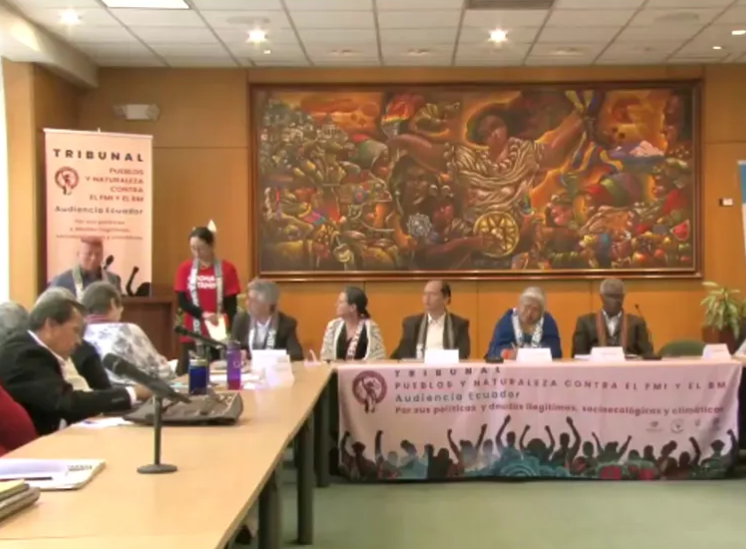
Summary
The hearing recorded testimonies from economists, jurists, indigenous leaders and activists who documented how the policies promoted by the International Monetary Fund (IMF) and the World Bank (WB) —and their regional allies— have intervened in Ecuador's economic and social policy from the mid-20th century to the present.
The Court's preliminary findings maintain that the interventions have resulted in:
- Constitutional and legal reforms with regressive effect on social and labor rights.
- Fiscal austerity which drastically reduced public investment, employment, and the state's capacity to respond in health and education.
- Privatizations (or transfer of management), opening to capital and measures that favored economic conglomerates and transnational actors.
- Environmental impacts severe consequences of extractive concessions, weakening of regulation, and financing of polluting industries.
- Institutional impunity and denial of real mechanisms for auditing and providing reparations to victims.
The court proposes concrete actions such as audits, declarations of illegitimacy of debts, and lawsuits for reparations to social and ecological victims.
Historical Context
Since their creation in 1944, the IMF and the World Bank have designed rules that condition the policies of countries in the Global South. The hearing argues that, beyond loans, there is a joint strategy of cross-conditionality and «"shadow conditionality"» which modifies laws and institutional frameworks without broad democratic processes. The historical pattern repeats itself: external debt used to condition reforms that favor subordinate integration into the global market.
Conditionality and Institutional Architecture
A central idea presented is the existence of converging conditionalities among the IMF, the World Bank, and regional banks (IDB, CAF). These operate as a set of instruments that promote:
- Fiscal consolidation: Reduction of public spending and increase in indirect taxes.
- Structural reforms: Privatizations, central bank independence, and regulatory changes that reshape the state.
Between 2019 and 2024, Ecuador signed significant agreements with the IMF. The letters of intent included adjustments equivalent to high percentages of GDP, resulting in thwarted economic growth and a loss of fiscal and regulatory sovereignty.
Macroeconomic Impacts
Economists detailed measurable consequences of adjustment programs:
- Growth loss: Billions of dollars of unrealized growth compared to alternative scenarios.
- Structural Unemployment: Hundreds of thousands of jobs lost as a result of the contraction in public investment.
- Investment Cuts: Investment in strategic projects fell to minimum levels, affecting infrastructure, health and education.
- Increased Informality and Emigration: Remittances grew in response to job losses, shifting the focus of development.
Beneficiaries and Capital Flight
The Court highlighted who truly benefits from these policies: large conglomerates, transnational extractive companies, banks, and local actors who are part of the circuits of economic power. Measures such as tax exemptions, the waiving of fines, and tax reforms favored the retention of income by these actors, while eroding the State's revenue-collecting capacity.
Cases and Ecological Damage
The Court's narrative places ecology at the center. Multilateral financing promoted extractive concessions and projects that increased ecological debt, degrading territories and affecting water sources, biodiversity, and the livelihoods of Indigenous and peasant communities. Constitutional protection of nature must be the cornerstone of any reparations.
Case 1: The Yoyakachi Tunnel and the Hydro-environmental Consequences
The project, which sought to divert water from areas of the Amazon, suffered cost overruns and technical errors, leading to land displacement and affecting high-altitude wetlands (swamps), key to water regulation. Community resistance was the only force that achieved a partial completion of the project, paying a high social and environmental cost.
Case 2: Santa Priscilla, the IFC and the Destruction of Mangroves (According to Complaints)
The IFC (the World Bank's private sector arm) financed the expansion of the aquaculture industry (Santa Priscilla/Prohemar) with approximately 144 billion. The complaints filed with the Court include:
- Expansion of shrimp farms over mangroves (the ecosystem went from ~350,000 ha to less than 158,000 ha).
- Displacement of coastal communities and loss of traditional livelihoods.
- Use of certifications (ASC, BAP) as mechanisms of "greenwashing" and legitimization without effective control over territorial destruction.
- Company registration in tax havens that hinders oversight.
Case 3: ProNACA and Financing for Mass Agroindustry (According to Testimonies)
ProNACA, the largest meat processor, received approximately $1.4 billion (IFC and IDB/IDB Invest). According to testimonies, the consequences in Santo Domingo and among the Sáchila people are severe: uncontrolled growth of poultry and pig farms (areas with more pigs than inhabitants), discharge of animal waste into rivers (nitrates and fecal coliforms), and animal rights violations. This also links animal industrialization to risks of bacterial resistance and emerging zoonoses.
Ecological Debt as a Mechanism for Resource Transfer
Diagram illustrating the components that define a debt as illegitimate, including purpose, legality, and social and environmental impact.
Audit and Illegitimate Debt
The most concrete proposal is the implementation of a citizen audit and the statement of illegitimacy of debt segments. Audit not only the amount, but also the purpose, the beneficiaries, and the legality of the instruments.
Audit Objectives
The Court proposes that the audit determine:
- If the funds were used in accordance with the Constitution (not for current expenses or purposes contrary to the public interest).
- Whether there was transparency in the clauses and whether democratic procedures were respected.
- If the required reforms violated rights and, therefore, generate obligations to provide reparations.
The people's tribunal format seeks to make victims visible, apply ethical criteria, and build a public record that serves as a basis for future legal claims.
Demands and Resistance
The demands made can be grouped into three essential areas:
- Truth and Audit: Rigorous research on the trajectory of indebtedness, contracts and conditionalities (2017–2024).
- Justice and Punishment: To hold politically accountable those who promoted unconstitutional reforms and to explore international legal avenues.
- Comprehensive Repair: Measures of economic restitution, environmental remediation, territorial restitution and public recognition of the affected communities.
Public Policy and Sovereignty Proposals
The communities and experts proposed concrete alternatives to restore social and ecological sovereignty:
- Moratorium and Restructuring of debt whose origin or purpose is illegitimate.
- Constitutional Protection of the public provision of essential services (water, health, education).
- Moratorium on New Extractive Concessions and transition policies towards degrowth models.
- Strengthening Progressive Taxation and combating tax avoidance by large companies.
Community resistance involves blockades, complaints to mechanisms of the international banking sector itself (CAO, IDB Invest) and coordination to promote alternative laws (such as a new Water Law that protects the resource as a common good).
FAQs
What is the legal scope of this court?
The tribunal is symbolic and ethical. Its rulings are not binding in the ordinary jurisdiction, but they seek to generate political pressure, a technical basis for subsequent audits and legal actions, and social legitimacy to demand redress.
Why are banks being blamed for the destruction of mangroves?
Because banking institutions (such as the IFC) directly financed the expansion of large aquaculture industries, such as Santa Priscilla, whose operations resulted in the documented destruction of mangroves and the displacement of coastal communities, despite having "sustainability" certifications.
What does it mean to declare a debt as 'illegitimate'?
This implies arguing that the debt was incurred for purposes contrary to the public interest, without democratic consent, or in violation of constitutional and human rights norms. Its objective is to relieve the population of the obligation to pay that portion of the debt and pave the way for reparations.
How can the Tribunal's process be supported?
Supporting involves disseminating the findings, participating in citizen audits, backing demands for transparency and alternative public policies, and accompanying communities in their processes of denunciation and mobilization.
Towards an Economic and Ecological Democracy
The hearing of the Peoples and Nature Tribunal against the IMF and the World Bank is a starting point: systematic denunciation, evidence gathering, and coordination among affected parties. The challenge is to translate moral and technical force into policies that restore rights and rebuild territories.
The Ecuadorian experience shows that imposing policies with serious social and environmental costs is not inevitable. Alternatives include fiscal sovereignty, environmental protection, and strengthening democratic mechanisms.
Do you want to help us create more content like this?
We work independently to share the best content on environmental and social analysis and activism.
DONATE NOW 
 EN
EN