The birth of pottery in America
On the coasts of present-day Ecuador, millennia before our era, the hands of ancient potters shaped one of the continent's most fascinating technological and artistic innovations: the first ceramic bottles in the Americas. These vessels, which emerged toward the end of the period of the Valdivia culture (approximately between 1800 and 1500 BC), represent a qualitative leap in the handling of materials and in the understanding of the thermodynamics of clay firing.
Today we know that this development was not an isolated event. The tradition of crafting these pieces flourished and was progressively perfected by the Machalilla culture, extending its influence along the coastal strip and into the Andean highlands with the Cotocollao culture, and penetrating deep into various areas of the Ecuadorian Amazon. This technological exchange demonstrates a highly sophisticated network of connectivity and knowledge transfer among ancestral populations, long before the consolidation of the great later empires.
Chorrera: the culmination of ancestral artistic expression
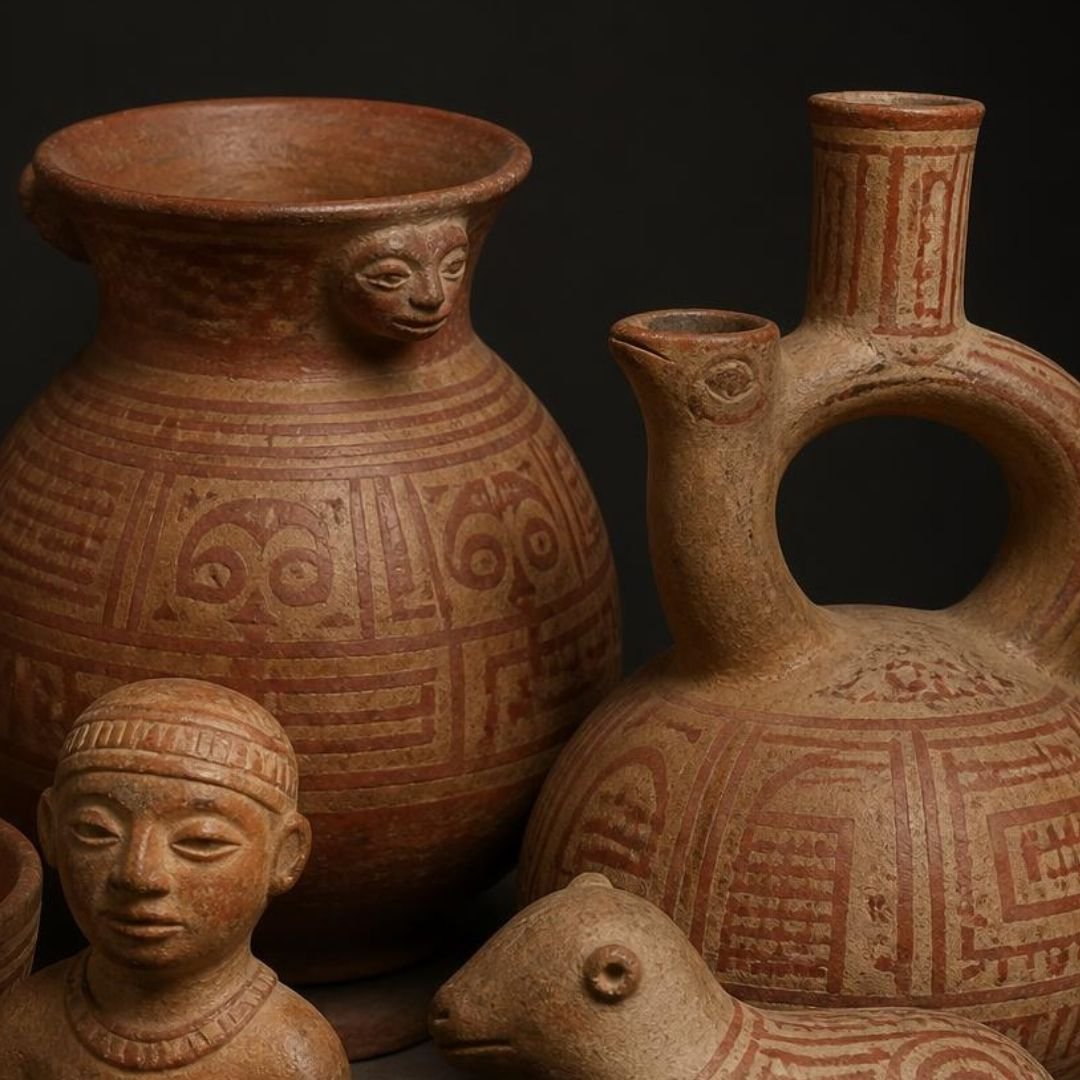
The Chorrera culture (1200–500 BCE) reached its peak in artistic and functional development. During this period, pottery transcended mere utility, becoming a first-rate biological and anthropological record. Chorrera potters applied what we would now call biomimicry, portraying with pinpoint accuracy the people, animals, and plants of their biodiverse environment.
The vessels mimic all forms found in nature with astonishing fidelity. We find representations of plants such as gourds, tubers, and local fruits, as well as a vast array of fauna including monkeys, fish, felines, and birds. The morphological accuracy is so high that contemporary biologists and archaeologists can easily identify the exact species depicted. Through these objects, the thinking of these peoples was captured, preserving their profound connection with the environment in which they developed, imprinting its natural symbols in enduring clay.
Acoustic engineering: The mystery of the whistle bottles
The most striking technological feature of these ceramics is the incorporation of complex acoustic systems. Occasionally, the bottles have an internal whistle that activates automatically when the liquid is poured. This ingenious feat of fluid dynamics and pre-Columbian acoustic engineering is particularly evident in the zoomorphic bottles, which are designed to reproduce the exact sound of the animal they represent.
The mechanism works by displacing fluids. Various forms exist, from single-spout pieces to complex double-spout systems or two communicating chambers. When the vessel is tilted, the liquid moves from one chamber to another, pushing the air inside through a narrow conduit where the whistle is housed. This principle of air pressure and acoustic resonance requires advanced empirical knowledge of fluid behavior and the acoustics of closed cavities.
Modern archaeological research indicates that this technique was not merely ornamental, but a ritual tool designed to "give voice" to the vessel. The sound emitted evoked the presence of ancestors and nature spirits during specific ceremonies, integrating the auditory dimension into the spiritual and communal experience.
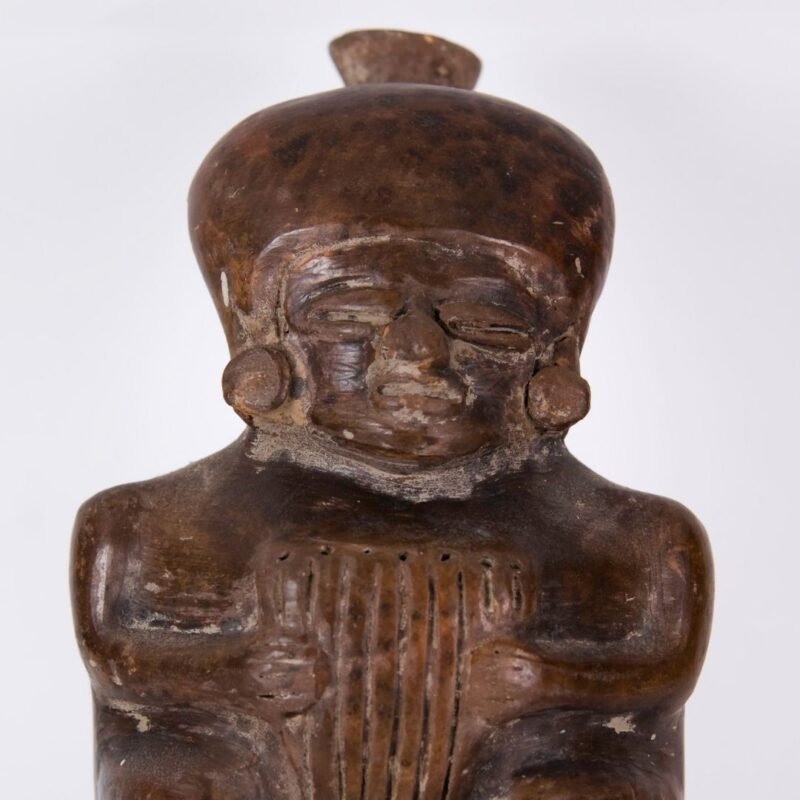
Ceramic whistle from the Manteño culture, Ecuador
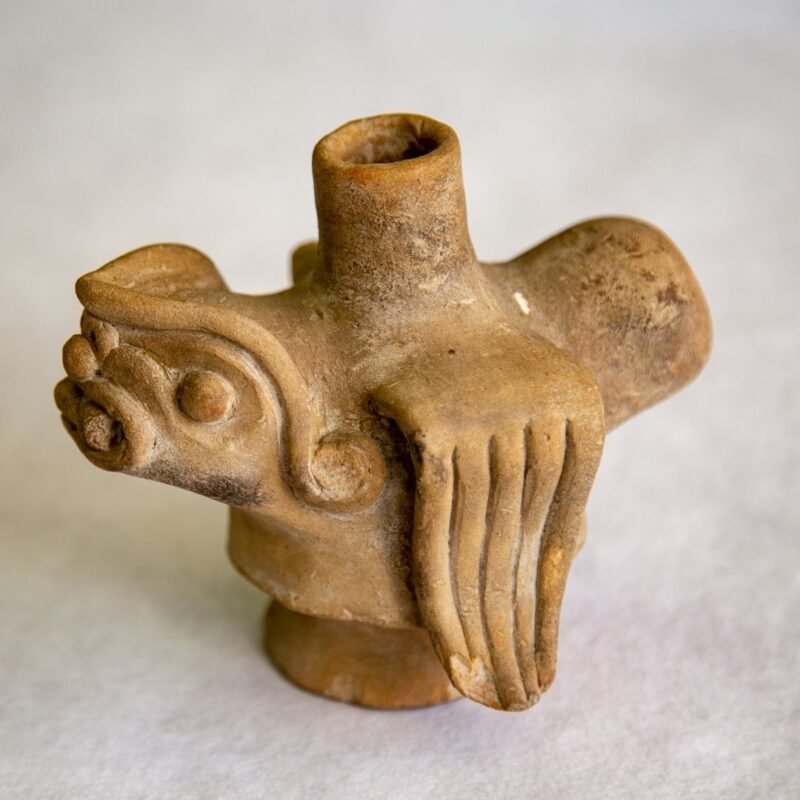
Whistle in the shape of an anthropomorphic spider from the Tolita culture
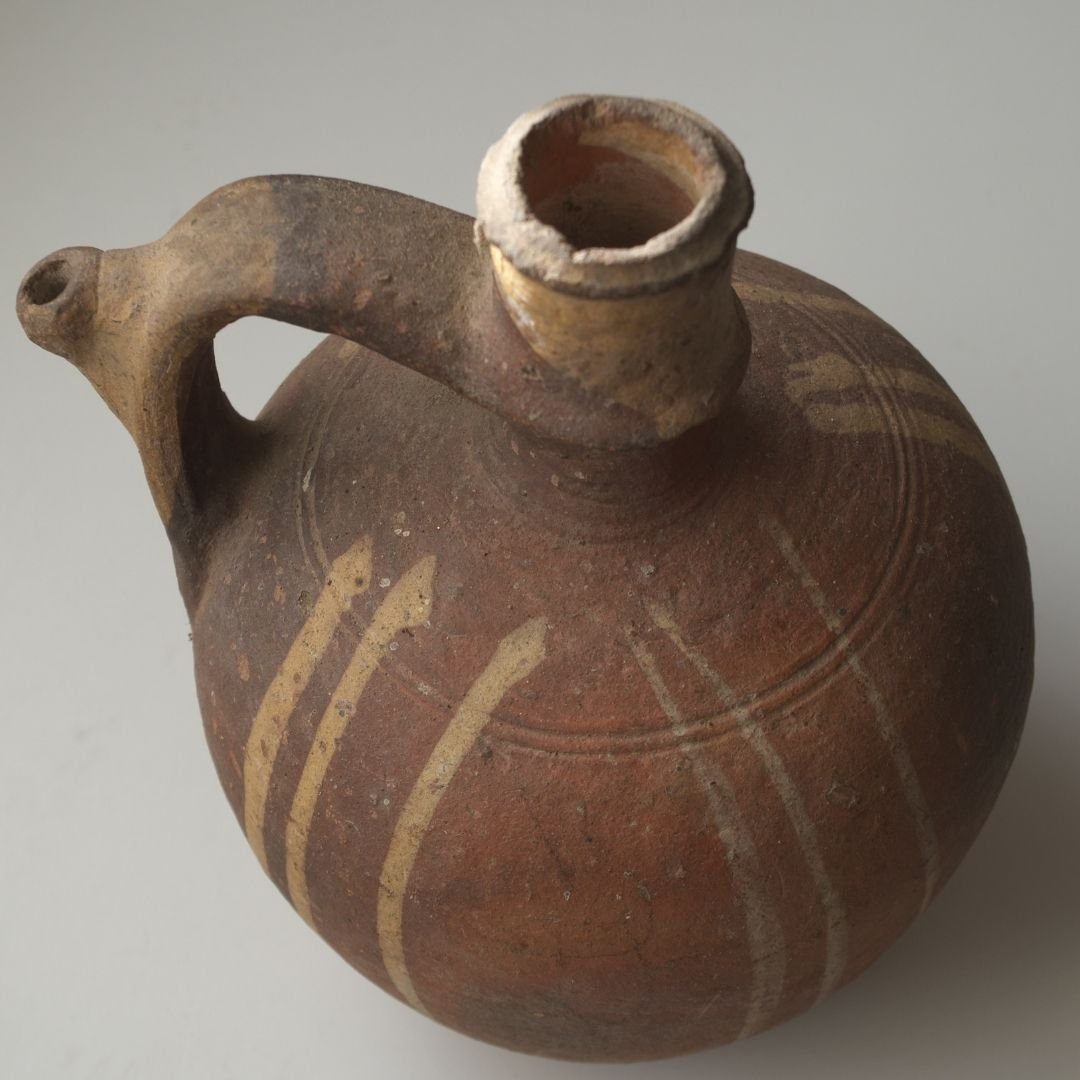
Chicha in funeral rituals
Bottles received their greatest attention and development in decorative and functional aspects, especially in rituals. They were primarily used in ritual libations of chicha, a beverage that requires precise biochemical knowledge for controlled fermentation using complex starches such as corn or cassava. Chicha acted as a bridge between the physical and spiritual worlds, and the bottles were the vehicle for this transmutation.
For this sacred reason, these vessels are often found in funerary archaeological contexts. The vessels formed an essential part of the offerings placed in tombs. Material evidence indicates that Indigenous American populations invested significant effort and resources in preparing funerary spaces, sometimes exceeding the attention dedicated to the construction of their own domestic dwellings. The ancestral abode required the best of the community's art and technology.
A continental legacy
The brilliance of these designs transcended the boundaries of time and geography. Native American artists preserved and adapted this custom for thousands of years. The use of sculptural, acoustic, and communicating-body bottles persisted in various later cultures within what is now Ecuador, and its influence spread south to the cultures of Peru, and north to blend with important pottery traditions in Colombia, Costa Rica, and Mesoamerica.
Scientific and Bibliographic References
Ontaneda Luciano, S. (2007). Ecuador, milestones of its pre-Columbian past. Central Bank of Ecuador. (Main reference on the chronology and expansion of ceramics).
Stothert, KE (2006). Expressions of ideology and ritual in the prehistory of Ecuador. Relationship on the use of acoustic instruments to "give voice" to the vessels.
Zeidler, JA (2008). The Ecuadorian Formative. In Handbook of South American Archaeology. Springer. (Supporting evidence for the chronology of Valdivia, Machalilla and Chorrera).
TO LOVE IS TO SHARE
Ancestral Agriculture: an answer for the future.
Can heritage agriculture provide answers from the past for the agriculture of the future? An analysis [...]
The Seed Route. From ancestral knowledge to peasant practices.
The Chilean documentary “La Ruta de las Semillas” helps to reveal, share and strengthen the [...]
Ancestral practices in water harvesting as a strategy for adaptation to climate change
Runoff carries mining waste into rivers (Llallagua, Bolivia) By Kashyapa AS [...]
PachaMama: the basis of Andean ancestral thought
The ancient inhabitants of the Andean world, that is, the original indigenous peoples, conceived the [...]
A new Ancestral Postmodernist Consciousness in the city of Guayaquil?
Thamé de Teatro de Artesanos in a performance on the day of the return of San Biritute [...]

 EN
EN